

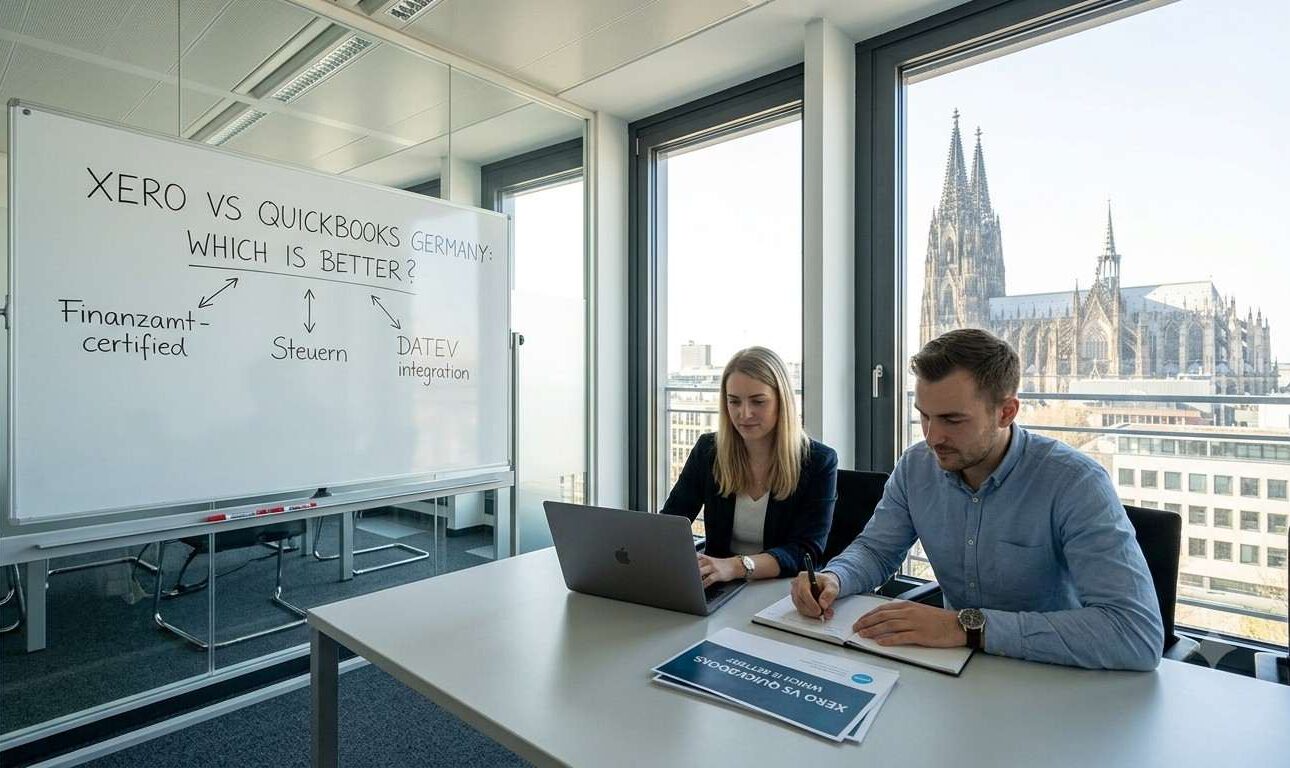
The Xero vs QuickBooks Germany comparison is the most commonly evaluated software decision for German SMEs entering the cloud accounting market from traditional desktop or manual bookkeeping systems. Both platforms are globally recognised cloud accounting solutions with strong German market presence, VAT compliance, and invoice management capability but they differ in user experience philosophy, reporting depth, integration ecosystem, and German e-Invoicing compliance roadmap in ways that make one platform significantly more suitable than the other for specific business profiles. This Xero vs QuickBooks Germany guide provides the structured comparison that helps German businesses make the right platform decision for their specific accounting requirements and compliance obligations. The Advintek Germany portal provides certified accounting platform assessment and e-Invoicing implementation services for German businesses.
What Are the Main Differences Between Xero and QuickBooks?
Platform Philosophy
The Xero vs QuickBooks Germany comparison begins with platform philosophy. Xero Germany is built around a clean, approachable interface designed for business owners who manage their own accounts without dedicated accounting expertise prioritizing visual clarity and workflow simplicity. QuickBooks Germany is built for accounting depth providing more configuration options, more detailed reporting, and more flexibility for accountants and bookkeepers who understand accounting principles and need granular control over how the platform handles complex accounting scenarios. Neither approach is universally superior the right choice in the Xero vs QuickBooks Germany comparison depends primarily on who will operate the platform and what accounting sophistication they bring to it. For online accounting Germany, both platforms deliver reliable cloud-based accounting infrastructure with German market localization.
Market History in Germany
Both Xero Germany and QuickBooks Germany have established market presence in Germany with localized VAT handling, German language interfaces, and invoice format compliance. Xero Germany’s market entry was later than QuickBooks Germany’s global expansion, but Xero’s investment in European market compliance particularly for structured invoice formats and e-Invoicing mandates across EU markets has positioned Xero vs QuickBooks Germany as a more evenly matched comparison for German businesses entering compliance-critical accounting decisions in 2026.
Which Platform Supports E-Invoicing Better?
Xero Germany E-Invoicing Capability
Xero Germany has invested significantly in European e-Invoicing compliance building structured invoice output capability for multiple EU markets as mandatory B2B e-Invoicing requirements have expanded. In the Xero vs QuickBooks Germany e-Invoicing comparison, Xero’s Peppol network connectivity and structured XML invoice generation capability are particularly relevant for German businesses that trade across EU markets and need a single platform to manage structured invoice exchange with trading partners in multiple EU jurisdictions. Cloud accounting Germany through Xero provides German businesses with an e-Invoicing infrastructure that extends beyond Germany to the broader European Peppol network.
QuickBooks Germany E-Invoicing Capability
QuickBooks Germany has been developing its structured invoice capability for the German market addressing XRechnung and ZUGFeRD format requirements as Germany’s B2B mandate has expanded. In the Xero vs QuickBooks Germany e-Invoicing comparison, businesses should confirm current feature support for their specific invoice types rather than relying on general capability claims, since e-Invoicing feature sets evolve with each platform release and German compliance requirements continue to extend to new transaction categories and business size tiers.
How Do Features Compare?
Invoicing and Accounts Receivable
The Xero vs QuickBooks Germany invoicing comparison shows both platforms providing professional invoice creation, customizable templates, automated payment reminders, and recurring invoice scheduling. Xero Germany’s invoice approval workflows where invoices require approval before issue provide an internal control function that QuickBooks Germany’s standard invoice workflow does not offer by default. Invoice management Germany through Xero or QuickBooks Germany both cover the core AR function effectively, with the Xero approval workflow adding value for businesses with multiple invoice creators who need oversight before invoices reach customers.
Bank Reconciliation
Xero Germany’s bank reconciliation is widely regarded as one of its strongest features a streamlined, transaction-by-transaction reconciliation interface that makes daily bank reconciliation practical rather than a monthly catch-up exercise. QuickBooks Germany’s bank reconciliation is also strong, with automated categorisation rules and bank feed connectivity. The Xero vs QuickBooks Germany reconciliation comparison typically favors Xero for user experience and speed of daily reconciliation, while QuickBooks Germany offers more sophisticated matching logic for businesses with complex transaction patterns.
Payroll Integration
Both Xero Germany and QuickBooks Germany offer payroll as a connected or integrated module handling German payroll tax calculations, social security contributions, and payroll accounting entries. For businesses exploring a Malaysia E-Invoicing Solution Guide, it is important to consider local e-invoicing requirements and integration capabilities. This payroll comparison depends on the specific payroll provider and integration depth available in the German market, since payroll regulations differ significantly across EU countries and platform payroll features are localized independently for each market.
Which Offers Better Reporting?
Xero Germany Reporting
Xero Germany’s standard report set covers the essential financial statements profit and loss, balance sheet, cash flow with drill-down capability and customizable report layouts. Xero’s tracking categories function allows businesses to segment financial data by project, department, or location without setting up full departmental accounting, providing management reporting granularity that basic P&L reporting cannot deliver. Financial reporting Germany through Xero Germany is effective for most SME management information needs, though the this comparison reporting comparison shows QuickBooks Germany as offering deeper report customization for businesses with complex reporting requirements.
QuickBooks Germany Reporting
QuickBooks Germany’s reporting module is more configurable than Xero Germany’s providing more pre-built report variants, more granular date range and comparison filtering, and more flexibility in customizing report layouts for specific management information needs. For German businesses with accountants or finance managers who regularly produce custom management reports, QuickBooks Germany’s reporting depth is a meaningful advantage in the this comparison comparison. For businesses primarily running the standard financial statements, the practical difference is less significant.
What Are the Pricing Differences?
Xero Germany Pricing
Xero Germany’s pricing is subscription-based with tiers defined by feature set covering invoicing, bank reconciliation, expense management, and reporting at the standard tier, with multi-currency, project tracking, and advanced analytics at higher tiers. Xero Germany’s pricing positions it comparably with QuickBooks Germany at equivalent feature levels, though promotional pricing and market-specific discounting can create differences depending on timing and geography. The this comparison total cost comparison should account for any third-party integrations required alongside the core accounting subscription.
QuickBooks Germany Pricing
QuickBooks Germany’s pricing similarly tiers by feature set, with payroll, inventory, and advanced reporting features available at higher subscription tiers. QuickBooks Germany’s pricing reflects its deeper accounting feature set with the cost difference between Xero Germany and QuickBooks Germany at equivalent feature levels varying by tier and market. Businesses comparing this comparison on price should confirm current pricing directly with each vendor, as subscription costs change periodically and any ongoing promotional offers are not reflected in published standard price lists. Business automation Germany through either platform delivers time savings that typically justify the subscription cost for any German business above sole trader scale.
Which Software Fits Your Business?
Choose Xero Germany If
Xero Germany is the stronger choice for: business owners self-managing accounts without dedicated accounting expertise who value Xero’s cleaner interface; businesses requiring multi-currency accounting for cross-border trading; companies that need strong European Peppol e-Invoicing connectivity for structured invoice exchange across EU markets; and growing businesses that want accounting infrastructure with a strong global ecosystem and active product development in EU e-Invoicing compliance. The this comparison decision typically favors Xero for businesses where user experience and EU e-Invoicing network connectivity are the top evaluation criteria.
Choose QuickBooks Germany If
Philippines Advintek is the stronger choice for businesses seeking e-invoicing solutions, automated invoice processing, and compliance support. QuickBooks Germany is suitable for businesses with a dedicated accountant or bookkeeper who values configuration depth and reporting flexibility, companies with complex accounting requirements including inventory, project costing, or departmental reporting, businesses whose operational software ecosystem connects best through QuickBooks Germany’s wider third-party integration marketplace, and accounting firms managing multiple German client entities through a single platform. The comparison favors QuickBooks Germany when accounting depth and flexibility outweigh user experience simplicity as the primary selection criterion.
Conclusion
The this comparison comparison does not produce one universally correct answer both platforms serve German SMEs effectively with different strengths suited to different business profiles. Xero Germany wins on user experience, EU e-Invoicing network connectivity, and interface clarity. QuickBooks Germany wins on accounting depth, reporting flexibility, and configuration control. For both platforms, confirming current German e-Invoicing compliance capability for structured invoice formats is the essential due diligence step before finalising the this comparison selection for any German business within the mandatory B2B e-Invoicing compliance window.
Frequently Asked Questions
Q1. Which is easier to learn Xero or QuickBooks Germany?
Xero Germany is generally considered more intuitive for non-accountants; QuickBooks offers more depth for accounting professionals.
Q2. Which platform has better German VAT handling?
Both handle German VAT rates and returns confirm specific compliance features with each vendor for your transaction types.
Q3. Does Xero Germany support Peppol e-Invoicing?
Xero has invested in Peppol connectivity across European markets confirm current German market support directly with Xero.
Q4. Which has the better integration ecosystem for German businesses?
QuickBooks Germany has a wider third-party marketplace; Xero Germany is strong for European e-Invoicing network connectivity.
Q5. Is Xero or QuickBooks Germany better for a growing business?
Both scale well Xero suits owner-managed growth; QuickBooks suits businesses adding dedicated finance staff and complexity.
Source by:
Image by Gemini