


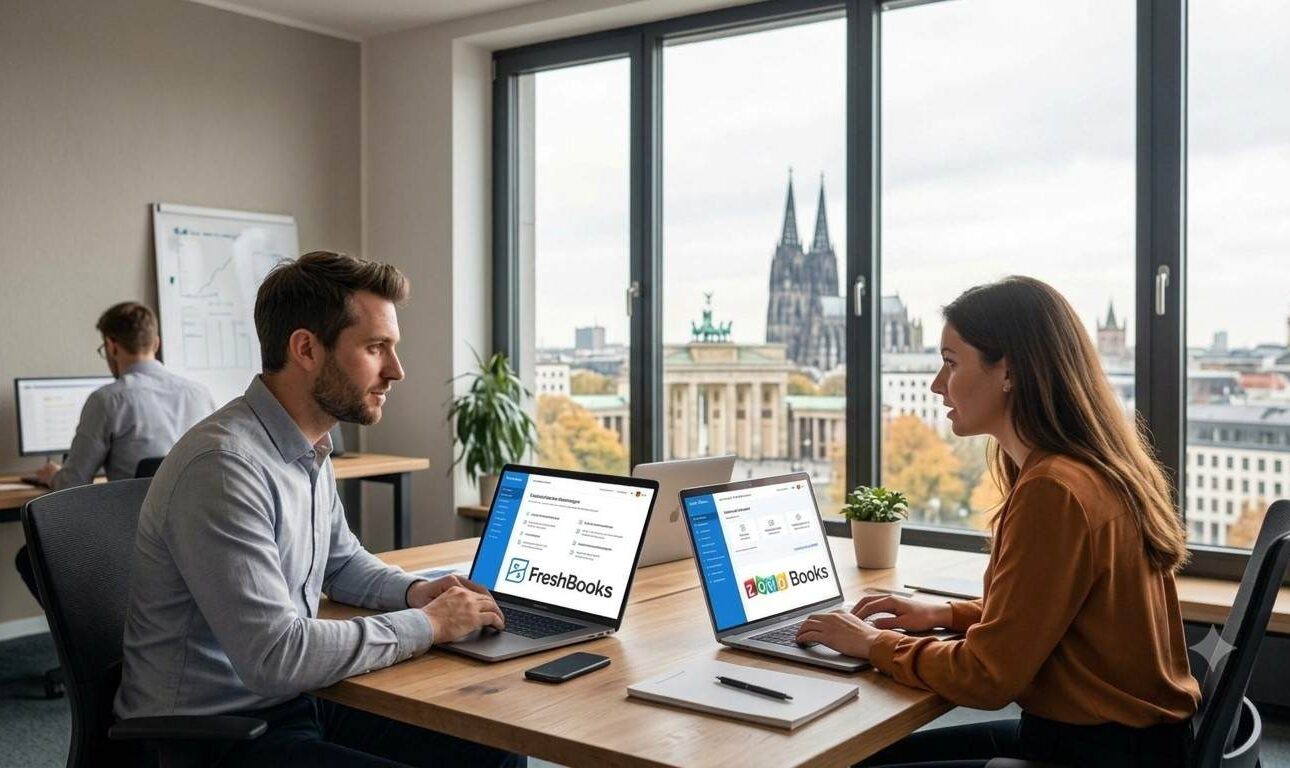
FreshBooks vs Zoho Books Germany is one of the most debated accounting software decisions for German freelancers, small businesses, and growing SMEs navigating both day-to-day financial management and the increasingly demanding German e-invoicing compliance landscape. Both platforms have earned strong reputations in the European market FreshBooks for its intuitive invoicing and time-tracking experience, and Zoho Books for its comprehensive accounting depth and native e-invoicing integrations. Choosing between FreshBooks vs Zoho Books Germany requires evaluating e-invoicing readiness, XRechnung and ZUGFeRD support, German VAT compliance capability, ERP integration depth, and total cost of ownership. The
What Are FreshBooks and Zoho Books?
FreshBooks: Built for Service-Based Businesses
FreshBooks is a cloud accounting platform originally designed for freelancers and service-based businesses. In the FreshBooks vs Zoho Books Germany comparison, FreshBooks is recognised for its streamlined invoicing workflow, client-facing portal experience, and intuitive time-tracking integration. As a leading
Zoho Books: Full-Stack Accounting for Compliance-Heavy Environments
Zoho Books is Zoho Corporation’s cloud accounting platform providing a comprehensive double-entry accounting engine, native e-invoicing compliance modules covering XRechnung and ZUGFeRD formats, and tighter integration with German VAT workflows. As a fully capable
Which Is Better for Invoicing in Germany?
FreshBooks Invoice Features
FreshBooks delivers an exceptionally polished invoicing experience with a guided invoice builder, automatic payment reminders, client portal access, and multi-currency invoicing. For German freelancers billing European clients, FreshBooks’ speed and ease of use is a genuine competitive advantage. Combining strong invoicing with
Zoho Books Invoice and E-Invoicing Features
Zoho Books provides native support for structured electronic invoice formats including XRechnung and ZUGFeRD the two German e-invoicing standards businesses must support under Germany’s B2B e-invoicing mandate. In the FreshBooks vs Zoho Books Germany comparison, this native structured invoice capability means Zoho Books users can generate mandate-compliant B2B invoices directly without middleware. Advanced
How Do Automation Features Compare?
FreshBooks Automation Capabilities
FreshBooks offers automation features well suited to the service business workflow automatic recurring invoice generation, automated payment reminder sequences, late payment fee configuration, and bank feed import for expense categorisation. For freelancers and service businesses with predictable recurring billing cycles, FreshBooks’ automation eliminates manual invoice generation overhead that monthly retainer billing otherwise requires. The platform’s intuitive design makes it accessible for
Zoho Books Automation and Workflow Features
Zoho Books delivers a broader automation stack covering recurring invoice scheduling, automated payment reminders, bank reconciliation automation, purchase order to invoice matching, and approval workflow configuration for invoice processing. For German SMEs with multiple stakeholders involved in invoice approval finance managers reviewing supplier invoices, department heads approving purchase orders, and accounting staff processing payments Zoho Books’ workflow automation enables structured, auditable approval processes that reduce both processing time and compliance risk.
What Reporting Tools Are Included?
FreshBooks Reporting
FreshBooks includes a practical reporting suite covering profit and loss statements, revenue by client and project, expense reports by category, and accounts receivable aging summaries. For German freelancers and small service businesses, FreshBooks’ reporting adequately covers day-to-day financial management needs and standard German VAT reporting requirements.
Zoho Books Reporting
Zoho Books provides a comprehensive report library covering the full range of financial statements balance sheet, profit and loss, cash flow statement, trial balance, and general ledger — alongside business-specific reports for sales, purchases, expenses, inventory, and tax. German businesses using Zoho Books can generate VAT summary reports that directly support German Umsatzsteuervoranmeldung preparation, reducing the manual reconciliation that platforms without native German VAT reporting require.
Which Platform Is More Affordable?
FreshBooks Pricing Structure
FreshBooks uses a client-count-based pricing model where subscription cost scales with the number of active billable clients rather than features or user count. For freelancers and consultants with a small number of clients generating high individual billing values, FreshBooks’ pricing model delivers good value. However, in the FreshBooks vs Zoho Books Germany comparison for SMEs with large customer bases, FreshBooks’ per-client pricing can become expensive as the billable client count grows beyond the base tier limit. Malaysia Advintek helps businesses explore e-invoicing solutions that support invoice automation and local compliance requirements.
Zoho Books Pricing Structure
Zoho Books uses a tiered feature-based pricing model where higher tiers unlock additional users, automation rules, custom reporting, and advanced features such as workflow automation and purchase order management. For German SMEs that need the full accounting depth of Zoho Books’ higher tiers, the total cost compares favorably against standalone accounting platforms that charge separately for each add-on module.
Which Solution Fits German SMEs Best?
When FreshBooks Is the Right Choice
FreshBooks is the stronger FreshBooks vs Zoho Books Germany choice for: freelancers and independent contractors whose primary accounting need is fast, professional invoicing with integrated time tracking; service businesses with straightforward VAT requirements and a small number of regular clients; and businesses whose team members need to access the platform on mobile with minimal training.
When Zoho Books Is the Right Choice
Zoho Books is the stronger FreshBooks vs Zoho Books Germany choice for SMEs with structured B2B invoicing requirements that need native XRechnung and ZUGFeRD compliance, businesses with growing accounting complexity requiring full double-entry bookkeeping, inventory management, and multi-currency reconciliation, and companies already using Zoho CRM or other Zoho applications that benefit from native cross-platform data flow. For businesses exploring the Top E-Invoicing Software Singapore, evaluating local compliance requirements and accounting integration capabilities is also essential.
Conclusion
The FreshBooks vs Zoho Books Germany decision depends primarily on invoicing complexity, e-invoicing compliance requirements, and accounting depth needs. FreshBooks excels for freelancers and service businesses prioritising invoicing speed and user experience. Zoho Books excels for SMEs prioritising accounting completeness, native German e-invoicing format support, and scalable workflow automation. Businesses whose top priority is XRechnung-compliant structured invoice generation without middleware will find Zoho Books the more immediately compliant FreshBooks vs Zoho Books Germany selection for the current German e-invoicing mandate environment.
Frequently Asked Questions
Q1. Does FreshBooks support XRechnung invoicing for Germany?
FreshBooks has limited native XRechnung support most German B2B compliance requires middleware or manual XML export.
Q2. Does Zoho Books support German e-invoicing standards?
Yes — Zoho Books provides native XRechnung and ZUGFeRD structured invoice generation for the German market.
Q3. Which is cheaper FreshBooks or Zoho Books for a German SME?
FreshBooks prices by client count; Zoho Books by features. Zoho Books is typically more cost-effective for larger client bases.
Q4. Can FreshBooks handle German VAT reporting automatically?
FreshBooks supports VAT calculation but lacks native German Umsatzsteuervoranmeldung report generation.
Q5. Which platform is better for German freelancers?
FreshBooks is generally preferred by German freelancers for its faster invoicing workflow and simpler user experience.
Source by:
Image by Gemini